Featured

Da Heck Does Quasi-Smart mean?

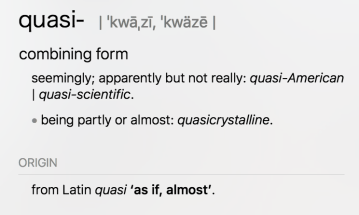
I first saw the phrase “quasi-” in George Orwell’s 1984 in 10th grade. However, once I saw the definition, I freaking loved the concept. The exact definition is right here:

Looking at the Latin origin, it means “as if, almost.” This will come into importance later.
Screen Shot 2018-09-02 at 11.59.57 PM.png

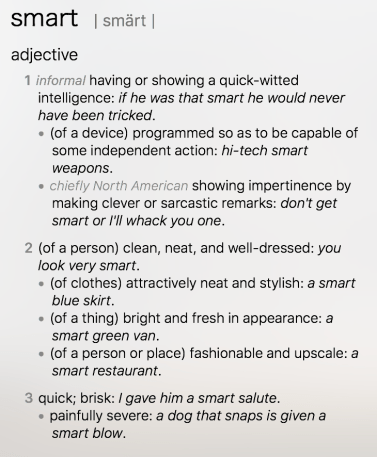
Now, let’s come to the smart aspect: once again, here is the exact definition:
Screen Shot 2018-09-02 at 11.58.40 PM.png

Clearly, I am using the first definition for “smart” here. In conjunction, quasi-smart would go to describe a person who is essentially intelligent, but not really completely there. However, I want to put a different perspective on smart.

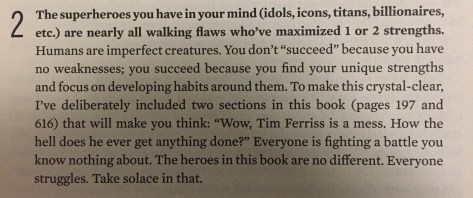
Let’s image in a person in a state of being that’s perfect – happy with his job, life, family, ambitions, characteristics, personality, health, interpersonal skills, etc, etc. A person of this caliber would be considered as having a high aptitude, or in other words, smart. This state of perfection, which I am calling smart, is unreachable. We have to remember, that no person is perfect: the idols we have are going to be messed up in some aspect of their lives. As Tim Ferriss said in Tools of Titans:
IMG_0782

HOWEVER – while we may never reach perfection, we can get as close as we can to it till we can essentially be considered perfect. Essentially means “Quasi” and perfection can be replaced with “Smart”…

BAM We got Quasi-Smart.

Something to address though: the gap between being Smart and Quasi-Smart is something that is intended to get smaller and smaller as time goes by. My math-minded brain can explain it like this – if there is a plotted of my knowledge over time, there will be an asymptote at a state of perfection (Asymptote: A line that continually approaches a given curve but does not meet it at any finite distance.)

IMG_0783
I know, my handwriting is trash. I’m sorry I work on this near midnight 😬

That idea that we are closer and closer to reaching a state of pure-awesomeness excites me. It’s a sign that there is always room to grow and learn but also able to approach a better state of life at the same time. This journey is also something I label as Quasi-Smart.

Now, one last tangent: in Harry Potter, Dumbledore has a tool called the “Obscurus.” It allows him to view his memories back in time. While I can never look at these memories in the same magical way that the all-powerful wizard can, the most I can do is think back to the memories I have and visualize them the best I can and learn from those moments: the happy, the sad, the anxiousness, the excited, and everything in between. By writing it out in a journal, those thoughts become solidified and by putting these lessons on the internet, they become permanent road marks of my journey.

That’s what this project means to me.

LES GO.

Featured

What’s up?

HEY.

Welcome back to the website where I will at one point be more consistent with my blog posts, but my last post was literally the night before my flight to India, where I was there for three weeks so give me a break for now. Currently, I’m in Dubai which is super fun – I’m enjoying the sights here a lot. I mean, look at this picture from the Burj Khalifa.

IMG_0684

Alright, now that I’m done with the blogger stuff, here’s the plan: I want to start writing more. After this trip, I’m more excited to get back into this, tackle more issues and figure more stuff out – getting from Quasi-Smart to Smart (more on what the heck that means coming soon). In the meanwhile, I just want to write this when things are relaxed and when I’m happy and excited, as well as show something awesome.

I haven’t edited this post so this is probably really scatterbrained and has grammar mistackes, but things are good. Also, here’s another awesome thread that I saw today, I think you’ll enjoy it too. Click on it for the full thread, it’s a beautiful piece of storytelling.

LES GO.

A New Coat of Paint

Almost 6 years ago, our family finally decided to paint my room. As we walked over to the pain pallettes at Home Depot, I had visions of my own palace, making my own HGTV renovation in my head. The chance of creating my dream room: it was finally mine.

Looking at the plethora of colors, my mind suddenly came a blank. “Which one do I choose?” I wondered. Suddenly, a thought came over me.

“I want to be different!” After seeing so many dull, muted colors, I finally narrowed my choices to one of these three different colors: a dark, navy blue; a sunset golden yellow, and best of all, a bright neon green. To get an idea, of this color, this color could be used as a green screen. It wasn’t the most beautiful color. However, this color stood out to me the most – it was whimsical, it was fun, it was energetic, it was exciting.

About two minutes into the conversation, my parents and I eliminated the dark blue – it could make the entire room feel smaller than it actually was, and with limited room space (and unknown dead space), that was a risk I couldn’t afford. That led to the amber yellow versus the green-screen green. My parents wanted the former color (which in retrospect is probably the better color) while I defended my color to the death.

This was the first time I took a stand against my parents. We argued at Home Depot. We bought some trial paints, and we argued some more. After going back to Home Depot to hopefully find another color to compromise on, I was always coming back with crazy color ideas, which led to more arguing.

There was only one mentality for me at that point: I need to stand by my principle of making my own choice.

At last, after making rebuttal after rebuttal (in other words, constantly begging and being a stubborn middle-schooler), I convinced my parents (they gave up dealing with me) and we chose that green. That’s the story of how I made my first decision. It’s also the story of how I made myself enjoy a bright green room.

Fast forward to today, we finally decided to change the color of my room. Today, the walls are no longer the harsh green, but a gentle sky blue that makes you feel like you’re on a cloud, miles above the air (except if you are afraid of heights…then choose another really relaxing position and equate that to my room). This energetic vibe was transformed into a zen haven. It was a bittersweet moment: the primary decision I made was being replaced by what would be a more refined decision. Interestingly enough, this color was partially chosen by my parents (they handed me a set of color palettes and I chose which one I liked).

It could be seen as me covering up my stand and falling to the will of my parents, but I see this differently.

This is a change made from an increase in my knowledge of decent interior decorating skills, or fundamentally, it’s a change resulting from a growth in knowledge. It’s a growth in my maturity in being able to accept the advice of my parents, yet still, compromise to choose a color that I like which ultimately led to a much better result.

This change is a new coat of paint for me: it’s a sign that I’m getting better, even if the old days seemed much more simple.

Wow, I just got emotional from paint drying. In some ways, that’s kind of beautiful.

I Finally Did It

  • “Give vulnerability a shot. Give discomfort its due. Because I think he or she who is willing to be the most uncomfortable is not only the bravest, but rises the fastest.” – Brené Brown

After wanting to create a blog for so long, I finally sat down, put my fear in a corner and made it stay there while I made this.

Fear? Let me explain.

Throughout my 4 years in High School, I have been doing Lincoln-Douglas debate. This format uses a philosophical basis to argue points, such as Resolved: Public colleges and universities in the United States ought not restrict any constitutionally protected speech or  Resolved: The United States ought to promote democracy in the Middle East.

I have spent countless hours trying to make cases, do research, prepare rebuttals, present arguments only to lose competitions. Over and over, no matter what I tried to do,  I failed over and over. I was the captain of the debate team, and while I had a strong understanding of the sport and the skills required, I couldn’t prove to myself that I was worthy of the position. Pulling up a computer and opening a Google Doc caused my muscles to tense up, my heart beat faster and faster, sweat formed on my forehead.

So what did I do? I ran away from it. I wrote as little as I could and I couldn’t confront this failure head-on.

It’s been awhile since my debate season has ended and I’ve graduated from high school. Yes, I learned public speaking and research skills, alongside leading a team to create more successful debaters. However, that idea of struggling to write has always been stuck in my head. And even more, I somehow still had the respect of all my peers despite not having the best records in debate. Why? How?

I think answer is writing more. Putting words on paper (er…a screen) to understand my brain and learn from all of that. I’m done running. I want to attack my failures now and see how far I can go.

I’m going to be terrified. I’m going to struggle. I’m going to fail. I’m going to be vulnerable. That’s the point.

Les go.

A 5th Grade Book Report

My earliest public speaking memory is in 5th grade where we all had to make these shoe boxes for a book, analyzing different aspects of story elements (characters, plot, setting, etc). For a 5th grader’s shoebox project, what I made was it’s pretty standard. It covered everything the rubric asked for. I had a piece of paper where I was reading of a script in what was pretty much a monotone voice. It was also 15 minutes until recess so every time I looked up at the crowd, their faces were flickering towards the clock.

You might be wondering “Hey Harish, if this is so standard, then how do you remember it so well?”

While I was in the car driving to school on the day of the presentation, my dad and I were discussing why a certain character was put into their difficult situation. Being that 5th grader, I constantly asked “why” over and over again, just the way your three-year-old cousin would keep asking you to annoy you. Why? Probably cause we just learned cause-and-effect in class (See what I did there, heh heh heh).

The thing was, I was able to answer these why questions, going on for a solid minute. My dad said, “you should just say that in the presentation.”

I responded by saying “But that’s not in the rubric,” to which he said, “So what?”

Fast forward to the end of the speech, everyone in the room gave the generic claps they give all the students, waiting for the next person to go to slowly approach the glory outside on the swingsets and slides. However, instead of sitting back down, I awkwardly proclaimed “Here’s another random thing I wanted to mention,” and I proceeded to go on the trail of cause and effect, and saw my teacher’s eyes widen in astonishment, with students averting their gaze from the clock to me. After I concluded, I got some actual applause and a congratulations from my teacher.

Looking back on this moment, I now realize that this inadvertently taught me something huge: don’t be afraid to be extra.

This fascinating cause and effect happened because I had the gaul to do something else that was exciting to me. Sure it wasn’t on the rubric, but I enjoyed it so why should I not present it?

When I say “extra” in this case, it’s not covering all the information and having 10 slides about one topic. It’s about concisely presenting something you enjoy in addition to what you need to cover. By placing these tidbits, you get excited about showing them, and your listeners will then feel that energy.

Think about it this way – when you go to Chipotle, your meal isn’t an entire bowl of guac. It’s alongside the rice, beans, meats, whatever. Having it as a condiment makes the entire meal reach a new level of 5-star fast food, but the guacamole is not the meal itself. That’s why it’s extra.

What that analogy, you see why a little extra is great.